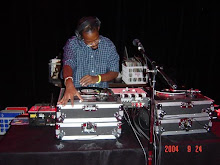
Sunday, January 8, 2012


Vinyl vs. Serato Scratch Live Debate
There has been a
long standing battle in the hip hop dj world between what’s been considered
“real djing” versus “digital djing”, and there are djs who stand on both sides
of the fence on this decade long issue.
Vinyl records have been equally as important as the turntable itself in
the hip-hop world. Ever since the
inception of the Technic 1200 turntable in the late 1970s, hip-hop djs have
used only vinyl for their amazing party rocking events for years.
That all changed
around 2004, when a New Zealand company called Rane introduced a digital dj
software program called Serato Scratch Live Serato Scratch Live.
Serato had already been around since the late 1990s, but the Scratch
Live element brought a completely new twist on how djs manipulated sound with
vinyl records. I remember first hearing
about this program around 2006 when I was an undergrad at the University of
Colorado-Denver.
A fellow dj
classmate of mine told me about a program that uses mp3 files in the same way
vinyl has been used. I came from the
vinyl area and this sounded too good to be true, because of how new and
innovative that this idea was at that time.
I remember my friend taking me to his house so I could see this “Serato”
for myself, because I was just too skeptical about djing with mp3s on
turntables. In a dj’s mind, playing with
anything besides vinyl was absolute blasphemy in the highest form, and I was
determined to never let digital take over my dj talents.
Once I had overcome
my prejudice about this program, I eventually bought my own and began
experimenting with it at home. This was
a phenomenal experience for me, because I had been used to vinyl records all of
my life. I had only dealt with mp3s for
a few years before this on my home computer.
I also had been used to carrying 6-8 milk crates full of records up and
down stairs, hallways etc. for 10-15 years anyway.
To make a long
story short, this program actually made djing fun again for many people, and it
made travelling with your equipment much easier to haul around. Now all you need in order to dj a gig is to
have your turntables, mixer, laptop, and Serato itself.
There are still
some djs who refuse to use it, and even some that feel you have to earn it
through using vinyl records first. I
have included a video by a famed hip hop producer named DJ Premier who started
off with vinyl, but has since began using Serato Scratch Live as well. I agree 100% with the comments that he had
made in the video and I hope that others will understand vinyl’s importance in hip-hop.
At some point,
audio and digital would have had to meet in the music world, but I think
overall that this program was a blessing to djs worldwide. At the same time, there has been some
backlash from purists (myself included), who felt that “new school djs” needed
to know the history of djing before using Serato. There is unfortunately a misconception about
djs now, and that all you need to dj is a laptop and headphones.
Serato has been
both a blessing and a curse at the same time, but regardless of others views on
its worth, I am happy to now be a digital dj more than ever.
Sources: http://serato.com/about
http://hiphopwired.com/2011/10/20/dj-premier-breaks-down-vinyl-vs-serato-video/
Saturday, December 10, 2011
Online Music Distribution Problems For Start Up Companies
There was a very interesting article about digital distribution that I had read by way of www.cnet.com. The article spoke about potential problems that some starts up companies have faced in trying to distribute music online, and there were some good suggestions on how to improve it. According to Matt Rosoff, a service called Speak Heart allows artists to sell songs through the service’s digital store, and the artist has complete pricing discretion.
This pricing discretion is good on one hand, but on the other hand, the service keeps 25 cents per song sold by the artist. Another problem with a start up service like this one is that most mainstream artists already have their own distribution; so many unknown artists will continue to live in obscurity without any recognition (Rosoff, 2008). Most of these unknown artists are not able to build a fan base online, because their not being given the exposure that they need to break in.
A good suggestion that Rosoff mentioned about was to possibly have a mainstream artist featured on the site to help bring traffic. I believe this is probably what CDBaby and some other services have possibly done to breakthrough with unknown artists. Another service called eMusic had an advantage over Speak Heart, because it has been around for over 10 years already. Speak Heart was really knew, so the uphill battle for recognition was probably pretty steep.
The author mentioned some good advice for beginner artists that are trying to build their fan base. He said “ if you’re a beginning artist, I still think the best recipe for success is to give full downloadable samples away on your home page or MySpace, then sell your music through a service like CDBaby or Tune Core” (Rosoff, 2008). I am not sure how many artists have really taken heed to this kind of advice, but I believe it would help a lot of unknown artists become mainstream much easier.
Source:www.news.cnet.com/8301-13526-_3-9887085-27.html
Friday, December 9, 2011
Some Current Music Publishing Issues
I had read an article online on www.americansongwriter.com, about some recent changes in the music industry regarding music publishing, and the direction that the music industry is heading in. According to Tune Core founder Jeff Price, he states, “ in the new music economy, a songwriter will have the most power” (Inman, 2011). This is due to the drastic change that major record companies and its artists are facing and how both will survive in the new digital age.
He also believes that songwriter revenue will increase and that the revenue of major record labels will drop from this change. The article also mentions that major record labels will begin to look more like artist management companies, and will offer more 360 deals to milk as much money from their artists as possible (Inman, 2011). The major labels sound like they are seriously in decline, and that the power of the business will fall into the hands of the artists themselves.
According to the website, if record companies continue to decline, then more artists and their managers will seek distribution and marketing deals directly, which will really put the majors in dire straits. An interesting point made in the article, spoke about how artists can collect their own royalties without having to be affiliated with a Performance Rights Organization.
That is where Tune Core and few others come inn, because this service allows artists a way to cut out the middleman when collecting royalties. Tune Core gives artists a chance to make more money from song sales and Internet streams, and works for self-published and non-published writers as well. Of course, the industry is not pleased with the waves that are rippling throughout the music business, but I am happy to see the power is going back to the rightful hands of the independent musician.
Source: http://www.americansongwriter.com/2011/12/a-new-frontier-in-music-publishing/ Wednesday, November 2, 2011
Industry Expert Blog
I recently read three very interesting cases in the entertainment industry regarding some legalities going on with music and film. These topics were discussed on a podcast called Entertainment Law Update and the host’s name was Gordon Firemark, Esq. The first topic that I really found interesting, was about the recent ruling on a case involving Star Wars creator George Lucas, and the prop designer of the Storm Trooper character that he hired for the movie.
This was mind blowing to say the least, because George Lucas commissioned the designer Andrew Ainsworth to use Lucas’s drawings to create the mold for the actual character that was used in the movie. After the success of the movie’s release in 1977, Ainsworth setup a website to sell the costumes of the Storm Trooper from the original film and Lucas did not appreciate that.
George Lucas filed a lawsuit against Andrew Ainsworth and the case went all the way to the British Supreme Court. To make a long story short, the court ruled in Ainsworth’s favor, saying that he could sell the costumes on his website and there wasn’t anything that George Lucas could do about it. The judge ruled that the costumes are functional works and not artistic works, which allowed Ainsworth to dodge the copyright infringement bullet (BBC, 2011).
The Court of Appeals and the High Court had previously ruled in Ainsworth’s favor, but Lucas felt that infringement did occur in the United States. Andrew Ainsworth does not own any assets in the Unites States, but resides in the United Kingdom and Lucas could not win in the United Kingdom (BBC, 2011). If this issue had began in the United States, then Lucas might have had won this case. It really blew me away that George Lucas lost this case, because he is the creator of the Star Wars brand.
I was shocked about this case, because I thought that George Lucas had more protection over his franchise than this. I am not sure why he did not have the sculpture trademarked somehow, so the prop designer would still have to get his permission for use.
The second case that I found that was interesting to me was about the Hangover 2 film and the lawsuit against Warner Brothers by a tattoo artist seeking damages. One of the characters in the movie had a tattoo on his face that was exactly like the one that former boxer Mike Tyson made famous.
The tattoo artist by the name of Victor Witmill had designed a tattoo for Tyson and the tattoo was featured in the film. The article mentions that Warner Brothers copied the tattoo without asking Witmill’s permission, and ended up placing the tattoo on another actor’s face (Belloni, 2011).
I remember hearing about this case and I wondered what was going to happen at the end of it. Victor Witmill wanted to stop the film from being released, but the film still came out anyway in spite of the lawsuit. Warner Brothers ended up changing the cover of the DVD release of the movie, probably as part of the settlement.
The last podcast that I found was about Justin Beiber and a fan that invaded his privacy recently. The case involved a fan that somehow found Justin Beiber’s personal cell phone number and began texting the pop star repeatedly. Beiber ended up posting the fan’s phone number on his personal Twitter account, and the fan received 26,000 messages (Firemark, 2010).
It turned out that Bieber had four and a half million followers on Twitter, and the fan had to change his phone number (Firemark, 2010). It just goes to show that you should not invade another person’s privacy. This kind of thing could be a real headache to fight in the end. The podcast also mentioned that this case could possibly become a small claims issue, but did not say definitely that it will for sure.
I believe that some fans can really take things too far at times and this is one of those situations. Just because someone loves their fans, it does not necessarily mean that they want their privacy compromised. I am sure that I would feel the same way about having a fan that did something like this.
Thursday, October 27, 2011
Some Recent Lawsuits In Music
I have read three articles recently that were of a very interesting nature regarding legal issues in the entertainment industry. The first article I came across, dealt with a Russian social network site that has been providing unlicensed music to consumers online. The company is called VKontakte and is in big trouble with the Recording Industry Association of America, because of the unlicensed music that this service is providing.
The RIAA recently filed with the U.S. Trade Representative’s office on October 26, 2011, and mentions about how the social website is “undermining the growth of the international music marketplace” (Recording Industry Association of America, 2011). This type of thing upsets me, because I am sure that the industry is well aware of sites like this one that sells unlicensed music. It makes me think back to the Napster area and how much of a big deal it was at the time. It is a very interesting article that music biz insiders should check out.
The second article that I found spoke about a lawsuit between pop group The Black Eyed Peas and an unknown artist named Phoenix Phenom. The lawsuit was over the popular BEP song “Boom, Boom, Pow”, and Phoenix Phenom claimed that the idea came from her. The court determined that the songs were similar, but not similar enough to warrant infringement to Phoenix Phenom (Wolfe, 2011).
This article is a typical situation of unknown artists trying to get their 15 minutes of fame, and by suing a famous group supposedly would bring that fame. It is sad that some people have to resort to these kinds of tactics in order to make it big in music. There is always going to be some similarities between songs, but to sue somebody over it would take some serious proof on the plaintiff’s part.
The last article I came across dealt with Prince being sued by a New York perfume company. The lawsuit is because of the “Purple Rain” perfume that was named after Prince’s famous album, and Prince was accused of not holding up his end of the deal (Associated Press, 2011).
Prince was supposed to help promote the perfume, but never did which is what brought the lawsuit into play. As busy of a musician that I am sure that Prince still is, there is not reason that he could not have received some screen time for the promotion. He has not been in the public eye much lately, and I think that the promotion could have helped both parties a great deal.
Saturday, October 15, 2011
Steve Jobs: iSad (1955-2011)
I read an article on the LA Times’s website about the recent passing of Apple, Inc. CEO Steve Jobs, and how much he revolutionized the world itself. According to Randy Lewis, Steve Jobs rescued the music industry from the near death state that it was in, and had given music lovers new freedom in finding music (Lewis, 2011). Since the record industry was already on life support, because of online music piracy and file sharing of free music, Steve Jobs was in many ways the savior that the industry desperately needed.
According to Robert Santelli, Executive Director of the Grammy Museum in Los Angeles, said that Steve Jobs’ inventions of the iPod, iPad etc., have been just as important as the significance of the Sony Walkman and the Cassette (Lewis, 2011). I could not agree more, because Steve Jobs really made it fun to listen to and buy music again. There was a time when specific artists released an album, and I would really get excited when I could get it in different formats.
To be able to have music in multiple formats makes things so much easier to transfer from one form to another. Steve Jobs literally changed the way that we buy music and store it. Another interesting piece about the article that stood out, was about the impact of iTunes on the sales of single songs. In the first year of iTunes’s existence in 2003, digital downloads added up to 30 million. In the span of two years sales had skyrocketed to 1.2 billion song downloads, which is just insane to say the least in numbers alone.
I agree with many others that believe Steve Jobs was a true visionary who has single handedly transformed our world, and has created a fun music buying world again for all to enjoy (Lewis, 2011). I am sure that his passing with affect the world for many years to come, and I truly hope that his successor is just as passionate about humanity as his predecessor was.
Source: http://www.latimes.com/entertainment/news/music/la-et-jobs-music-20111007,0,653159.story